The Counterfeiters

Description
The Counterfeiters is considered to be André Gide’s magnum opus. The plot kicks off in 1920s Paris when Bernard, a young man preparing for a school examination, decides to run away from home. As he bounces around the city with his school friends, he meets Édouard, a writer who’s composing a novel titled The Counterfeiters—a novel-within-a-novel. We’re soon introduced to more and more characters, and their relationships and aspirations begin to swirl in a complex interplay, including a ring of counterfeiters trying to pass fake gold coins, a series of homoerotic affairs, and a nefarious count.
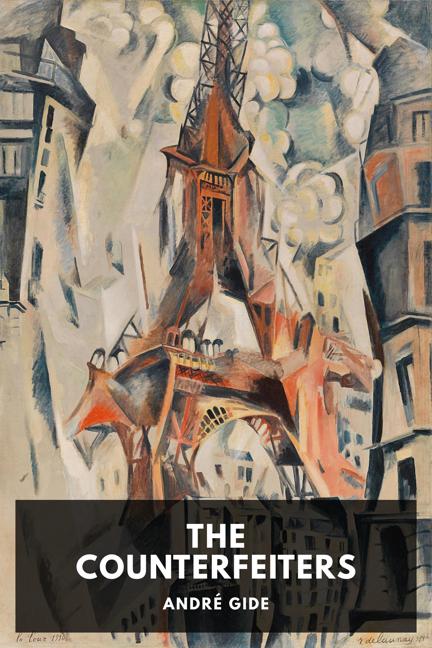
Gide was inspired by the Cubist movement in how he arranged the characters and plot, leading to unresolved plot lines, fractured timelines, and a kaleidoscopic narrative. Contemporary critics like E. M. Forster praised the attempt, but ultimately found it too confusing to be successful.
The novel is also a roman-a-clef, in which Édouard is a stand-in for Gide himself, and some of his contemporaries like Jean Cocteau, Marc Allégret, and Eugénie Sokolnicka are reflected in various characters. The novel is also notable for its frank depiction of not one, but several homosexual relationships.
Read free
This ebook is thought to be free of copyright restrictions in the United States. It may still be under copyright in other countries. If you’re not located in the United States, you must check your local laws to verify that this ebook is free of copyright restrictions in the country you’re located in before accessing, downloading, or using it.

Download for ereaders
-
Compatible epub — All devices and apps except Kindles and Kobos.
-
azw3 — Kindle devices and apps. Also download the Kindle cover thumbnail to see the cover in your Kindle’s library. Despite what you’ve been told, Kindle does not natively support epub. You may also be interested in our Kindle FAQ.
-
kepub — Kobo devices and apps. You may also be interested in our Kobo FAQ.
-
Advanced epub — An advanced format that uses the latest technology not yet fully supported by most ereaders.
Read online
A brief history of this ebook
More details
Sources
Transcriptions
Page scans
Improve this ebook
Anyone can contribute to make a Standard Ebook better for everyone!
To report typos, typography errors, or other corrections, see how to report errors.
If you’re comfortable with technology and want to contribute directly, check out this ebook’s GitHub repository and our contributors section.
You can also donate to Standard Ebooks to help fund continuing improvement of this and other ebooks.